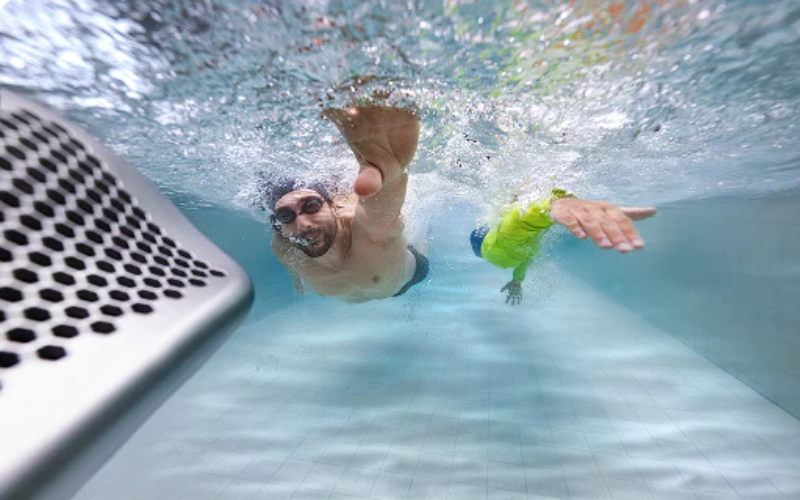
When people compare counter-current swimming systems, flow speed often gets most of the attention. It is easy to understand why. A faster current sounds more challenging and more suitable for strong swimmers.
But speed is only part of the experience.
Flow width can be just as important. A fast but narrow stream may feel difficult to stay inside. A wider current can support more of the swimmer’s body. This often creates a more stable and natural swimming experience.
For many swimmers, the best current is not simply the fastest one. It is the current that combines enough speed with enough width.
A Narrow Current Can Feel Strong but Unstable
Imagine swimming against a powerful stream that only reaches the center of your body.
Your chest may receive strong resistance. Your shoulders may move in and out of the main flow. Your legs may receive much less resistance.
This can make it harder to stay centered.
The swimmer may need to make constant corrections. Small movements to the left or right can suddenly change how much resistance the body feels.
That is not always ideal for training.
A wider current spreads resistance across a larger area. It gives the swimmer more room to move naturally while still swimming against steady water pressure.
This becomes especially important during longer sessions.
Flow Width Helps Support the Whole Body
Swimming involves the entire body.
The arms pull through the water. The legs kick. The hips need to stay high. The torso must remain balanced.
A useful counter-current should support this full movement.
When the flow is wide enough, resistance can reach the shoulders, torso, hips, and legs more evenly. The swimmer does not feel like only one part of the body is fighting the current.
This helps create a more balanced swimming position.
It can also make different strokes easier to practice. Freestyle needs space for arm recovery and body rotation. Breaststroke uses wider movements. Some swimmers also want room for relaxed exercise rather than strict lap-style training.
A broad swimming zone gives them more freedom.
High Speed Cannot Fix Poor Coverage
Increasing flow speed does not automatically improve the swimming experience.
If the current remains narrow, extra speed can make the weak points more obvious.
The center of the flow may become very strong. The outer area may still feel much weaker. This creates a sharp difference in resistance.
The swimmer may feel stable for one moment and lose the flow after moving only a short distance sideways.
That can become frustrating.
A better goal is useful resistance across the full swimming area. Speed can then be adjusted according to fitness level.
This creates a more predictable workout.
Wide Flow Can Make Longer Sessions More Comfortable
Endurance swimming depends on rhythm.
A swimmer needs to repeat the same movement many times. Breathing should become regular. Stroke timing should stay consistent.
An uneven current makes this harder.
If the swimmer is constantly trying to return to the center, attention moves away from technique and fitness. The workout becomes partly about position control.
A wider flow gives the swimmer a larger stable zone.
That does not mean the workout becomes easy. The current can still provide significant resistance. It simply means the resistance is easier to use.
For people who swim for twenty minutes or longer, this difference can become very noticeable.
Pool Size Also Affects the Right Flow
Flow width should match the swimming space.
In a very compact pool, an extremely broad current may not always be necessary. The swimmer has less room to move sideways.
In a larger pool, wider coverage becomes more valuable. There is more space around the swimmer. A broad current can make better use of that space.
This is one reason current systems should not be chosen by maximum speed alone.
Pool dimensions, swimmer ability, training style, and current coverage all matter.
A system that works well for relaxed daily exercise may not be the same system that works best for advanced training.
Choosing a Model Based on How You Swim
For swimmers who want a wider, fan-shaped current, the iGarden Swim Jet P Series is one option designed around broad water coverage as well as current strength.
Within the range, the P100 makes sense for beginners and lighter recreational swimming. It provides a more approachable starting point for users who do not need maximum resistance.
The P160 is better suited to casual swimmers and families. It offers more current output while still fitting everyday pool use.
The P200 is a stronger choice for regular swimmers. It is worth considering when exercise is a main reason for using the pool and the swimmer wants more resistance.
For advanced swimmers, the P230 is the model to consider. It offers the highest flow output in the range and is intended for more demanding training. The added power is more useful when the swimmer already has the technique and fitness to hold position against a strong current.
The important point is that these choices are not only about chasing a higher top speed. The wider flow area remains an important part of the experience.
Width Can Improve Technique Practice
A stable swimming zone can also help with technique.
Swimmers naturally move a little from side to side. Body rotation can shift the shoulders. A strong kick can move the hips. Breathing can also change direction slightly.
In a very narrow stream, these small movements may take the swimmer partly outside the main current.
A wider flow is more forgiving.
The swimmer can focus on hand entry, stroke length, breathing, and body alignment instead of constantly searching for the center.
This can be useful for swimmers who want consistent repetition.
It can also help when another person is watching the swimmer’s technique from the poolside.
Flow Quality Is About More Than One Number
Maximum speed is easy to compare because it gives buyers a simple number.
Real swimming comfort is more complicated.
A good counter-current needs enough speed for the swimmer’s ability. It also needs useful width, even distribution, and stable direction.
These factors work together.
A very fast narrow current may look impressive on paper but feel less natural in the water. A broad and controlled current can create a better training environment even when the swimmer is not using the highest speed setting.
This is why flow width deserves as much attention as flow speed.
The goal of counter-current swimming is not just to create powerful water movement. It is to create a swimming zone where the body can move naturally against steady resistance.
When the current is wide enough and the speed matches the swimmer, the result feels more controlled. The swimmer can focus on rhythm, technique, and endurance.
That is what turns moving water into a useful swimming experience.